
Why 'Rest' Often Isn't Enough


Rest is often given as a solution to letting an injury heal. For something minor — say if you’ve been overloading the body with intensive exercise — rest can be a good solution. However, it’s also a passive strategy, and not every ‘problem’ is solved through passivity — it’s just simply delaying solving the problem.
Rest can be a good thing
Rest is beneficial when the body is dealing with acute inflammation, minor overuse or fatigue. Allowing your body to take some time to reset and reduce load can allow you to go faster and/or stronger in the long run — it can also prevent you from continuous overload, which can lead to injury.
However, rest doesn’t solve
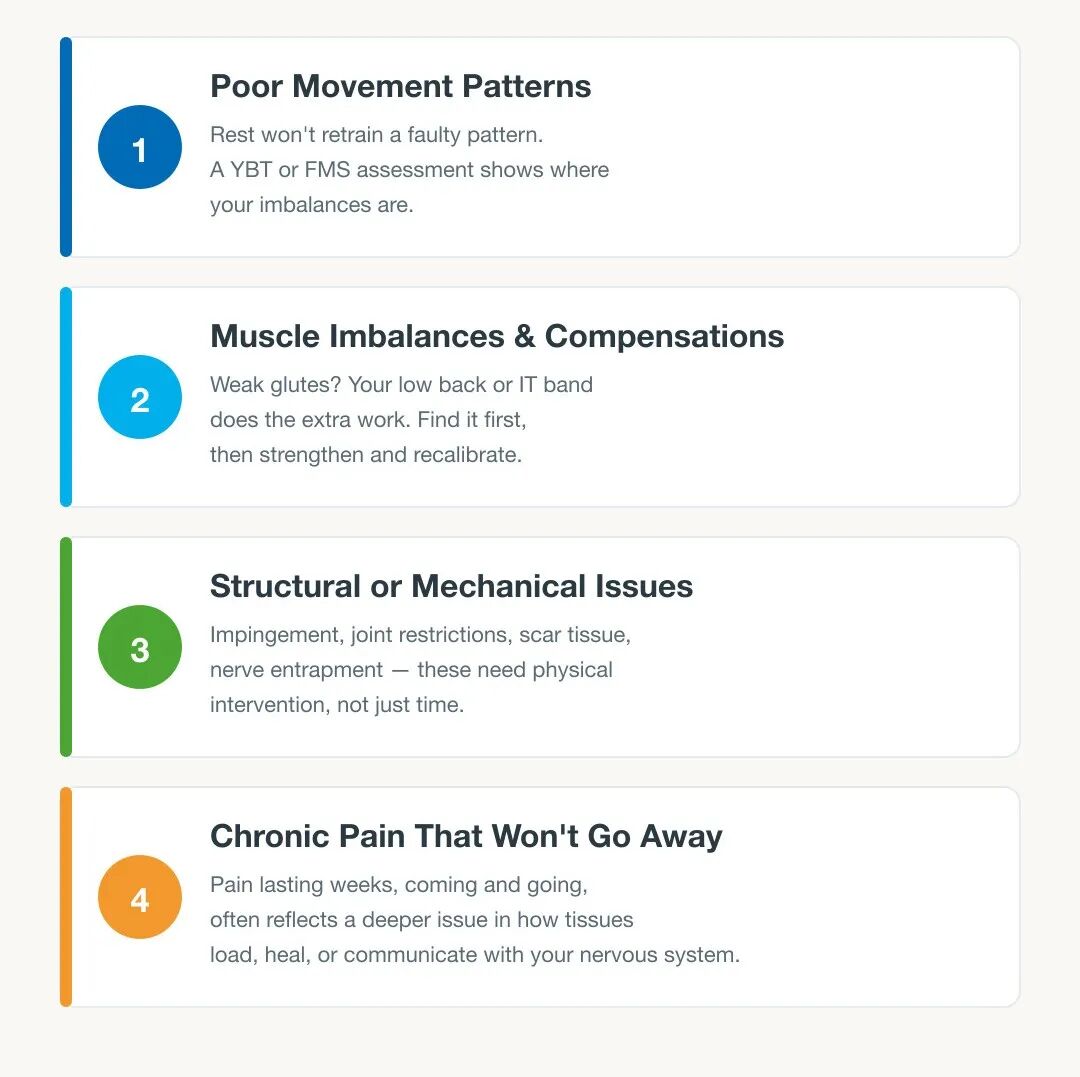
When ‘rest’ doesn’t seem to be solving the problem
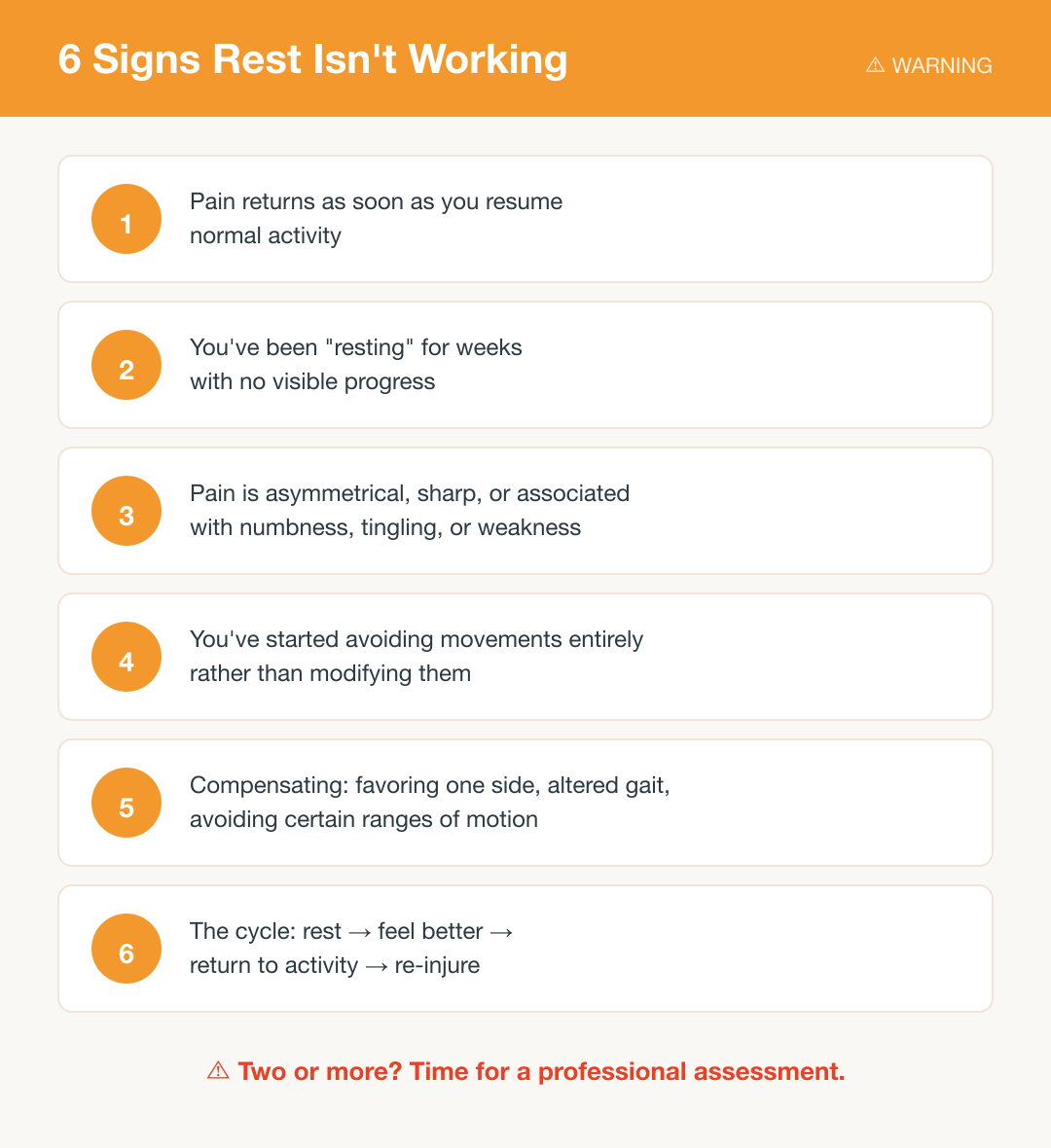
· As soon as you resume normal activity, the pain returns… even if you are training at a reduced level.
· You’ve been “resting” for an extended period of time and there doesn’t seem to be any progress.
· The pain is asymmetrical, sharp, or associated with numbness, tingling, or weakness.
· You’ve started avoiding a movement entirely rather than modifying it.
· And/or you’ve noticed that you’ve started compensating and favoring one side, changing gait or avoiding certain ranges of motion.
· The issue is cyclical in nature: rest, feel better, return to activity, re-injure.
So what can solve the problem? Start by seeing a physical therapist
A physical therapist first diagnoses why the problem exists — they don’t just treat the symptoms or ‘put a Band-Aid over the problem’.
To start, your physical therapist will assess your movement through an evaluation. They will look at how you move as a whole system — joint mobility, asymmetries, gait, etc. — to determine the actual source of dysfunction. Typically, this is not where the pain shows up! If you have knee pain, it could be stemming from the lower back; shoulder pain can typically be traced to the thoracic spine.
After going through an assessment, your physical therapist will load your body ‘smartly’ rather than avoiding loading altogether. Progressive, targeted loading helps tissue heal stronger and become more resilient. Rest doesn’t do that.
You might be surprised at what they find — a trained eye can catch movement compensations that you might not even be aware of, such as seeing how you lift your knee up to determine how your pelvis tilts.
Additionally, they might spot something that could also be problematic in the future that you may not even be aware of yet. Just like you would go to the dentist for a teeth cleaning to prevent issues, the same can be true for seeing a physical therapist — it can be preventative versus reactive.
Another part of a physical therapist’s job is to create a plan for you to return back to activity. They won’t tell you to just continue with what you’re doing and ‘see how it feels’ — rather, they’ll prepare a progressive plan to get you back to full training so you don’t have to guess.
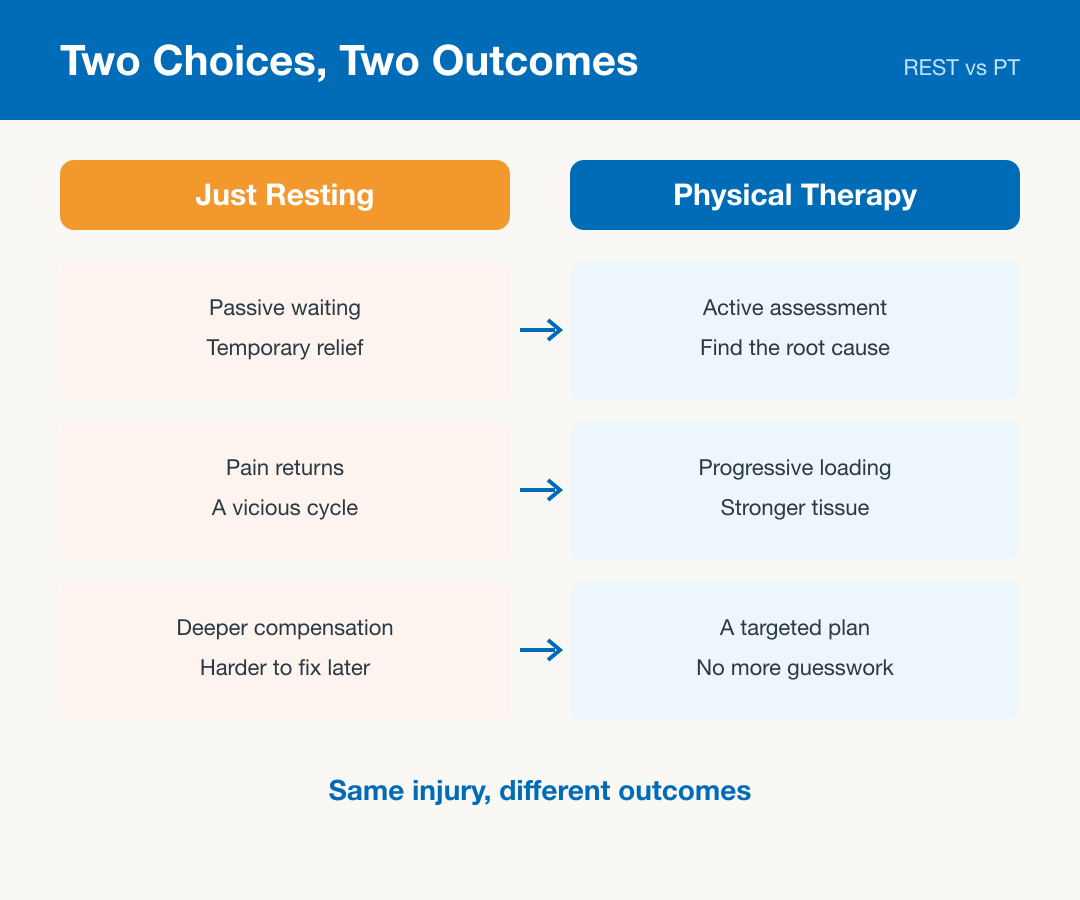
The worst part about just resting? You’re really just waiting
Wanting to rest and wait to see what happens makes sense for a lot of us — it’s free, simple, and in many cases we’re told to do so, sometimes by trained professionals.
But there can be a hidden cost to waiting too.
Delaying a professional evaluation can mean:
· Building onto a compensation pattern that gets more ingrained — making it harder to correct later.
· Secondary issues can develop as other parts of the body take on more load.
· The eventual solution takes longer, requires more work and more money than it would have if you went in early on.
By going in to see a physical therapist you’re eliminating the guesswork, wondering and waiting — in fact, you may just be able to return to the exercises and movements you love sooner than if you just rested and waited.
If you’ve been told to rest, but want a second opinion — and start moving forward in the right direction — schedule an appointment at UP. You’ll go through an initial evaluation to determine where those pain points are, and then your physical therapist will work on creating the right plan for you so that you can get back to your regular way of life.
本篇文章来源于微信公众号: 上海优复康复医学门诊部